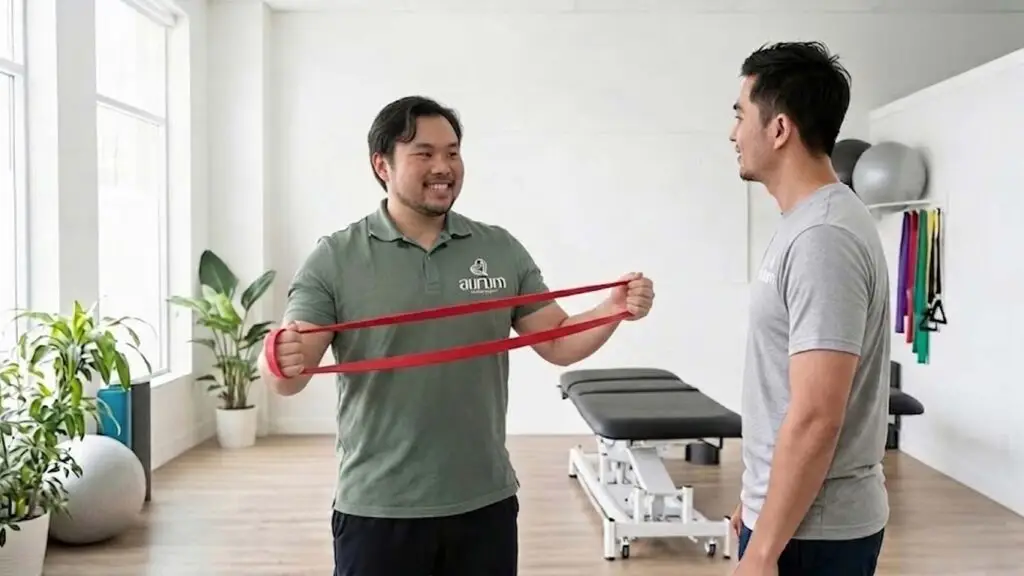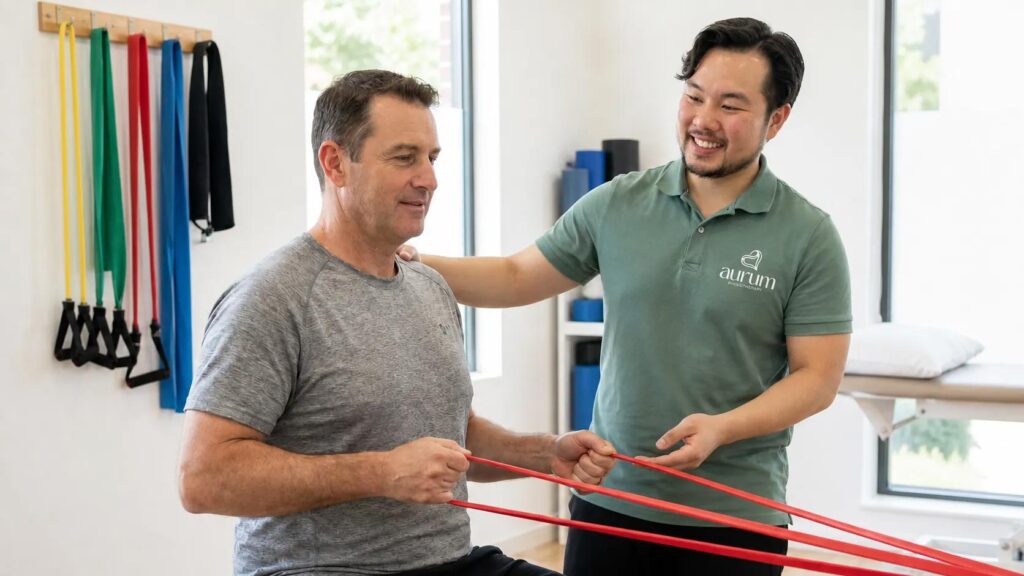
Exercise physiology for return to sport is often the missing link between "recovered" and "match fit". If you have just finished a round of physiotherapy and you are itching to get back to football, tennis, netball or whatever sport you love, an Accredited Exercise Physiologist (AEP) bridges the gap that physio alone leaves behind. At Aurum Physiotherapy, our team rebuilds the strength, speed, power and balance your sport demands, so you return to competition with confidence rather than crossing your fingers and hoping the injury holds. Based in Casula and serving the wider Liverpool area, we build every program around your sport, your goals and your injury history.
The problem is, most exercise programs are one-size-fits-all. But your goals matter. Training for raw strength looks completely different to training for speed, endurance, or the balance and coordination (proprioception) that stops you rolling an ankle in the first place. Get this wrong, and you can do everything "right" in the gym and still not see the results you are after.
Here is how our AEPs at Aurum Physiotherapy break it down. From our Casula clinic we work with people across Liverpool, Prestons, Lurnea and surrounding suburbs, and you can see the full service on our exercise physiology near Liverpool page. If you are still working through an injury, our physiotherapy in Casula team can get you to the starting line first.
Why "Cleared by Your Physio" Is Not the Same as "Ready for Sport"
Physiotherapy does an excellent job of getting an injury to heal, restoring your range of motion, and settling pain and swelling. But there is a gap between "pain-free" and "ready to sprint, cut, tackle or serve at full intensity again", and that gap is where a lot of reinjuries happen.
Exercise physiology picks up exactly where physio leaves off. Your AEP looks at the specific demands of your sport, the accelerations in football, the rotational power in golf, the repeated jumping in netball, and builds those qualities back up in a structured, progressive way.
It is the difference between being able to walk without pain and being able to trust your body under real match pressure.
The 5 Types of Training (And What They Are Actually For)
Not all training is the same, and the right mix depends entirely on what your sport demands. Here are the five qualities your AEP will train, and how each one is programmed.
Strength
Building muscle strength and neurological adaptation using resistance. We train it with heavy weights, 2 to 3 sets of 8 to 10 slow, controlled reps (80 to 95% of your max).
Endurance
Working against resistance for longer without fatiguing. We train it with lighter weights, 3 to 5 sets of 15 to 30 reps (30 to 60% of your max).
Power and Speed
Accelerating as fast as possible, every rep identical. We train it with light to moderate weight, 4 to 5 sets of 6 explosive reps (around 50% of your max).
Hypertrophy
Building significant muscle mass. We train it with 3 to 5 sets of 8 to 12 reps (60 to 80% of your max).
Proprioception
Improving body awareness and balance through space. We train it with 2 to 3 sets of 12 to 15 reps, starting with little to no weight.
Same Exercise, Different Goal
Most sports, football, soccer, tennis, golf, basketball, rely on explosive, powerful movement. So even a "basic" exercise can be adjusted to train a completely different quality depending on what you need.
- Squats for strength. Back squats with a heavy barbell, 2 sets of 8 reps. Slow on the way down, explosive on the way up.
- Calf raises for endurance. Light weight, aiming for 15 or more reps without fatiguing, building up the number over time.
- Bench press for power and speed. Usually thought of as a strength or hypertrophy move, but at around 50% of your max with a fast, explosive push, it becomes a power builder instead.
- Preacher curls for hypertrophy. Bicep curls on an incline bench isolate the biceps and increase time under tension, a small tweak that makes a big difference to muscle growth.
- Lunges for proprioception. The staggered stance throws off your centre of balance, forcing your quads, glutes and core to work together to keep you upright.
Movement is a medicine for creating change in a person's physical, emotional, and mental states.– Carol Welch
Learn how exercise physiology for return to sport can rebuild the strength, power and confidence your sport demands.
Make BookingWhat to Expect From an Exercise Physiology Program
If you have never seen an AEP before, the process is more thorough than "here is a list of exercises, see you next week". A typical journey looks like this.
- Initial assessment. Your AEP reviews your injury history, current physio notes (if relevant), your sport, and your goals, whether that is returning to competition, staying active, or simply moving with more confidence.
- Movement and strength screening. Before programming anything, they will assess how you currently move, where your strength or stability gaps are, and which of the five training categories above needs the most attention.
- A staged program. Programs are rarely static. You might start in the endurance and proprioception zones to rebuild a foundation, then progress into strength and power as your body is ready for it.
- Ongoing review and adjustment. Sessions are reassessed regularly. If something is too easy, too hard, or aggravating a niggle, the program is adjusted on the spot rather than waiting weeks to notice.
This is also where having your physio and exercise physiologist under the same roof helps. Alongside hands-on care like remedial massage to support recovery, your AEP can liaise directly with your treating physiotherapist, so your return-to-sport program is built on an accurate, up-to-date picture of your injury, not guesswork.
The Takeaway
Before you start any exercise program, get clear on your goal. A messy, uncoordinated program, even one full of "good" exercises, will not get you the results you are after if it is not built around what you actually need.
That is exactly what an AEP does. They take your goals, your sport and your injury history, and build a program around it. You show up and put in the work, they do the programming. You can read more about our exercise physiology services whenever you are ready.
Do I Need to Be Injured to See an Exercise Physiologist?
Not at all. AEPs work with the general, healthy population just as often as injured athletes. If you want an expert, evidence-based opinion on your training program, an AEP session is a great place to start.
Can an AEP Help Me Train for a Specific Sport?
Yes. Your AEP will draw on their knowledge of your sport, current research, and your personal goals to design a program that is genuinely built for you, not a generic template.
How Is Exercise Physiology Different From Physiotherapy?
Physiotherapy typically focuses on diagnosing and treating an injury, reducing pain, restoring movement, and healing tissue. Exercise physiology picks up from there, using structured exercise to rebuild strength, power and confidence so you can return to full activity, not just day-to-day life.
Do I Need a Referral to See an Exercise Physiologist?
You can book directly without a referral. If you have a chronic condition, your GP may also be able to refer you under a Chronic Disease Management (CDM) plan, which can make sessions more affordable. Ask our team if you think you might be eligible.
Ready to get back on the field? Book your return-to-sport exercise physiology session today and let us build a program around your goals.
Make Booking